York Minster History
|
This short history of York Minster is intended to introduce some of the stories behind the development, construction and traditions of this extraordinary cathedral and the people who helped make it what it is. In the Beginning
No-one knows when Christianity first arrived in the city, but by 306 when Constantine The Great was proclaimed Emperor in York, it is probable there was a small Christian community among those who proclaimed him. In 312 he issued a general edict of toleration for the Christian Church. However, by the year 314 York already had its own bishop, implying that the Christian community had been meeting there for some time, probably since long before their faith was officially tolerated.
A period of instability followed with York vulnerable to attack from Penda of Mercia and the Britons of North Wales. We know that the city was overrun at least twice and probably three times between the death of Oswald in 641/2 and the Battle of the Winwaed in 654/5. In about 670 St. Wilfred took over the see of York and found the structure of Edwin's church fairly lamentable 'The ridge of the roof owing to its age let the water through, the windows were unglazed and the birds flew in and out, building their nests, while the neglected walls were disgusting to behold, owing to all the filth caused by the rain and the birds.' Saint Wilfred set to work renewing the roof and covering it with lead, whitewashing the interior walls and installing glass windows. Based on descriptions given of other churches built at a similar time it is possible to understand something of how Wilfred's restored church at York would have looked to the 7th century worshippers who entered it. The altar, within which relics were deposited, would have been decorated with purple silk hangings of intricate woven design. Upon the altar, raised by a book rest and in a jeweled binding, would stand the illuminated gospel book. The walls and probably also the testudo (a wooden partition screening the altar) would be adorned with icons painted on wooden panels depicting the types and anti-types of the Old and New Testaments. These church painting were essential to the evangelization of England, being the only effective way of explaining the 'the new worship' to an illiterate population. Gregory the Great called them 'the books of the unlearned'. Saint Wilfred held the see of York for 40 years until 705 but only when not in dispute with Canterbury or for some other reason out of the country. His successors were much more in accord with the wishes of Canterbury and Rome, at last making York a center where both the Saxon and Roman church were at peace. In the period that followed until the arrival of the Vikings, the Church in York went through a great period in its history. Egbert, who ruled from 732 to 766 and was the first archbishop approved by Rome, hugely expanded the cathedral school and library, which became famous throughout the Christian world. The school's most famous pupil Alcuin, wrote a verse in which he listed the books in the church library. They included not only the Latin fathers, Jerome, Augustine and Gregory, and more recent authors like Boethius and Bede, but classical texts, Virgil, Cicero and Pliny among them. No other such school and library existed north of the Alps and York was truly at the center of civilization. Meanwhile, in 741 , the Minster Church had been burned down. The fire left the old church in ruins but the people of York were in a position to rebuild it and judging by the account of Alcuin it must have been a work of great splendor. He describes it as lofty, supported by columns, and having round arches and paneled ceilings. It contained thirty altars , and was surrounded by many beautiful side-chapels. In 793, after 'dire portents' in the shape of whirlwinds, lightning and 'fiery dragons…flying in the air' the first Viking attacks fell upon Britain, destroying the church of Lindisfarne. After years of sporadic attacks, the Viking army wintered in England for the first time in 855. By 867 the Danes were occupying East Anglia, and the following year they went north and captured York. Despite losing both their kings in the fight to repel the invaders the English seem to have negotiated a truce which left them in possession of the city; but in 892 the Danes restated their claim and the see of York was vacant for eight years. For the first half of the tenth century there is very little recorded history of the church of York. Occupied in turn by the Danes, the armies of the West Saxon successors of Alfred and Norse raiders from Ireland, it was not until the reign of Edgar that the English were safely in possession of the whole of Northumbria. These years were not, however, a time of entire depression, either for the city or its Christian population. The trading Vikings brought a measure of prosperity and the Anonymous Life of St Oswald in 980 describes York as a densely populated city, full of Danish merchants, even if its buildings were somewhat down-at-heel. The Minster survived and remained a center of Christian worship with archbishops continuing to serve, although they are little more than names to us. Some of the Danes even showed an interest in Christianity and as early as 895 a Danish king, Guthfrith, was buried as a Christian in the Minster. In 934 King Athelstan made the Church a very significant grant of land and in 946 King Eadred presented it with two large bells. Even so, the pagan element among the north-eastern Vikings made York an insecure base for a bishop in the mid to late tenth century. When the clouds of history rise again we find something altogether new; a line of archbishops, Benedictine monks but of Danish origin, restoring some semblance of order to the Christian life of the city and its Minster. The most distinguished of these were the second Saint Oswald, archbishop from 972 to 992 and Wulfstan from 1003 to 1023. The York of their day had become a largely pagan place, the most thoroughly Viking town of the whole Danelaw. Although none of these new monk-archbishops managed to restore a single monastery to the north they were far from negligible figures: it was the last of their line, Archbishop Ealred, who traveled south on Christmas Day 1066 for a truly momentous engagement… The Norman MinsterOn Christmas Day 1066 Ealdred anointed and crowned William the Conqueror king of the English in Westminster Abbey, an event which radically changed the course of history for Britain, York and its cathedral.
Perhaps the greatest change to the everyday life of the church in York after the arrival of the Normans was caused by the introduction of a secular Chapter. Archbishop Thomas, who died in 1100, reorganized his cathedral on an institutional pattern that survives to this day. In York, unlike some other medieval cathedrals, the foundation was never monastic. Thomas of Bayeux introduced canons living the common life at York, later converting the Chapter to conform with the model to which he had been accustomed in Normandy, a fully secular Chapter of canons living in their own houses, enjoying separate incomes or 'prebends'. From among this Chapter of canons the four offices of Dean, Treasurer, Precentor and Chancellor were created to manage the running of the cathedral, while the Archbishops themselves became increasingly significant national figures, often away from York on the business of King or Pope. In 1137 York Cathedral was damaged by fire. The worst damage was to the eastern arm with the remainder being as patched up or improved. Newly quarried limestone was used in repairs to the walls which were re-rendered with red lines as before. However, even if the eastern arm had not been damaged in the fire, it would have been antiquated by the standards of other large churches of the twelfth century.
The accession of Walter de Gray marks the most important turning point in the history of the medieval Minster. During the previous generation the clerks of the cathedral had suffered from the lack of an effective and respected leader. By formulating a strict code of conduct for members of the Chapter, regulating the size and distribution of prebend payments and , for the first time, keeping careful records of his acts, Gray redefined the position of the archbishop in his diocese and his cathedral. It was in 1220 that construction of the Minster as we know it began. Archbishop Gray and the Dean and Chapter decided to rebuild the Norman Minster on a scale to rival Canterbury. The South Transept was the first section to be rebuilt between 1220 and 1250 with the North Transept both started and finished a few years later. Both transepts were built in the Early English Gothic manner and with similar interiors. The very different atmosphere created in each transept is attributable to contrast between their end walls. The south wall is in an elaborate French style featuring gables, arcading and lancets thick on its surface with two tiers of doubled lancet windows below an ornate rose window. The north wall is so different it is hard to believe it was built at the same period: the Five Sisters, five tall, even lancets, rise above a blind arcade and are crowned by five graduated lancets in the gable. The effect is austere and graceful. While the South Transept is believed to have been the personal scheme of Walter de Gray it is his sub-Dean and eventual treasurer, John Romanus who is associated with the North Transept - whether the design was dictated by aesthetics or economics, it makes him a noble memorial.
Walter de Gray died in 1255 an elderly and wealthy man and his burial place is the Minster's most beautiful tomb, in the South Transept he and his Chapter created between the dark nave and choir of the Norman cathedral. The rebuilding of York Minster that began with the transepts went on almost continuously for two hundred and fifty years. The Chapter HouseWhen work on the North Transept was completed in the 1250s some of the masons who had worked on it moved straight on to the Chapter House which was begun in about 1260. Completely invisible from the inside of the church, the Chapter House and its vestibule are attached but separate with an architectural style altogether different from the main body of the Minster. While the rest of the interior is grand and majestic the Chapter House is exotic and delicate, experimental and in keeping with the Decorated style fashionable during the thirty years in which it was built. This contrast is appropriate. The Chapter House was built primarily for business. Here the members of the Minster Chapter, for the rest of the Middle Ages and beyond, administered the business of the richest corporation in the north of England.

By the 1280s, when the Archbishop, Chapter and their master-masons turned their attention to the nave they were surrounded by a just-finished, up to the minute Chapter House separate from the daily liturgical routine of the Cathedral. Down the passage and across the tranquil space of the North Transept stood Archbishop Thomas's old, gloomy nave, the only part of his church still intact. The decision to replace it with a new aisled nave, its vault even higher than the transepts, its interior lit by huge and complicated expanses of glass and tracery would involve the Minster in seventy years of building work. It was decided early on that the new nave should stand on the deep,
well-constructed foundations of the old Norman foundations, in this way the two
lines of piers would run directly westwards from the pillars that supported the
tower. In about 1320, when work on the nave had already been in progress for 30 years, it was decided to demolish Archbishop Roger's Norman towers and build a completely new west front with two new towers. What these western towers were intended to look like is now impossible to tell, since the front was finished only as far as the height of the nave roof with the present top story, parapet and pinnacles added at a much later date.
The intention of successive archbishops since the beginning of the new nave had always been to replace the whole of the Norman cathedral with a larger, more modern building. When Archbishop Thoresby laid the first stone of the new eastern arm in 1361 he was continuing a process that had already been going on for almost 150 years. The Zouche chapel (in memory of Thoresby's predecessor) and the vestries behind it had been started and the masons and carpenters who had finally completed the nave simply moved their tools and equipment eastward.
In the early 1390's, under Archbishop Thomas Arundel,
demolition of the choir, the only surviving part of the Norman building
commenced. During the decades that saw the building of the new choir the drama surrounding the throne of England produced repercussions in the see of York. Richard II had close connections with Archbishop Arundel and gave money for the work at the Minster. In 1396 he translated Arundel to Canterbury and York received an Austin friar Robert Waldby for its archbishop although in the two years left before his death he never actually visited the Minster. The Chapter elected a Yorkshire cleric, Bishop Skirlaw of Durham as Waldby's successor in 1398 but were immediately over-ruled by the now desperate Richard II who installed another aristocratic friend, Richard Scrope. A brave and learned man, Scrope nevertheless betrayed two kings and died a traitor's death. Only a year after Richard II had personally secured him the archbishopric, he was in the Tower Of London with other lords to hear the king's statement of abdication. In 1405 he led several thousand men in revolt against the new king Henry IV. After being tricked into surrender he was executed under the walls of York amid a huge crowd on the feast of St William.
During the middle of the fifteenth century the church was absolutely subordinate to politics. In 1465, as the conflict between the houses of Lancaster and York raged, Archbishop George Neville (bother of Richard Earl of Warwick, the Kingmaker) was enthroned at the Minster. It was a magnificent occasion, fraught with dynastic tensions, the Neville family parading their Yorkist allegiance. At the feast afterwards the chief guest was the Duke of Gloucester, who eighteen years later became Richard III. By this time the Minster was, at last, almost complete, the building program of two and a half centuries slowly reaching its close. Master Colchester's plan to rebuild the central tower with the bells in its second stage had been abandoned because of concern for the strength of the piers and foundations. Instead, the south western tower was designated the new belfry and the new central tower was raised only to the top of the lantern. In 1472 the Dean and Chapter decided that the Minster was at last complete and held a great re-dedication ceremony to mark the occasion.
The first protestant archbishop of York (and also the first to be married) was Robert Holgate. Throughout the reign of Edward VI he saw the Minster stripped of half its clergy, all its chantries and altars, much of its plate and treasure and the daily ritual familiar for centuries. He also handed over to the king sixty-seven manors, a large slice of the endowment of the see of York. However when Edward's Catholic sister Mary came to the throne Holgate quickly shed his wife and his protestant faith to save his skin. With the accession of Queen Elizabeth I the church settled in a compromise between the Catholicism-without-a-pope established as a state religion under Henry VIII and the Protestantism of those martyred or exiled under Mary. This has remained the basis of the Church of England ever since. Although Elizabeth was no bigot - she had noted the counter-productive effect of her sister's persecution - her archbishops in York set about removing every trace of the old ways from the Minster and the city. There was more physical destruction inside the Minster during the reign of Elizabeth than at any other period. To remove the lingering belief in purgatory and prayer for the dead, so strong an element in pre-Reformation worship, tombs, brasses, coats of arms, portraits in the glass windows and the memorials of many archbishops and Deans were removed along with altars, hangings and vestments. By the 1570s the Catholic Mary Queen Of Scots, and Philip of Spain were beginning to threaten England and an anti-papist campaign had become a necessity. Catholics in York were forced to listen to Protestant sermons in the Minster; by 1600 thirty-four of them had died for their beliefs.
In 1639 York became the effective capital of England. War with Scotland was expected and Charles set up his headquarters in the city. Although the final outbreak of civil war was delayed for three years, the alliance between the Scots and the parliament which Charles was compelled to call in 1641 put York at the strategic center of the realm. By the spring of 1644 York was entirely surrounded by roundhead soldiers and a siege commenced, lasting over 3 months. On 5 July Cromwell defeated the Royalists at Marston Moor, seven miles outside the city and the fate of the nation was decided. By this time the archbishop had fled to Wales and the Dean was in a London prison for debt. After the surrender, the parliamentarians held a victory service in the Minster although, unlike many cathedrals caught up in fanatical Puritan wrecking, it was never damaged (thanks largely to Sir Thomas Fairfax, Cromwellian general and Yorkshire gentleman, who allowed no damage to be done.) For sixteen years the Minster belonged to the citizens as never before or since. It echoed to puritan sermons attended by merchants and aldermen relishing the absence of pomp. With the restoration of Charles II in 1660 the pendulum swung back again as bishops were restored, revenues and authority returned to Deans and Chapter, and the reappearance of the Book of Common Prayer, organ music, altars and the Anglican ceremonial.
Dean Markham (1802-22) commenced the first major restoration of the outside of the cathedral. The west front was repaired and the long disused chapel of the ruined archbishop's palace was made into a new library. In 1829 a disastrous fire, started by a madman, destroyed the roof of the eastern arm, the choir stalls and the organ. Subscriptions towards the hugely expensive repair work were generous but did not meet the whole cost. In 1840 a second fire, started accidentally, burned down the nave roof and left the nave , the south west tower and south aisles as shells. This time the public response was less generous and by the 1850s the Minster was deeply in debt. In all the centuries of its history this was the moment when the Minster's fortunes were at their worst. Attendance was in decline, the music was in a poor state, and the Dean had, for a time, stopped the celebration of even a weekly Communion. It wasn't until the appointment of Augustus Duncome, an aristocratic cleric,
in 1858 that the Minster's fortunes began to improve. Duncombe had no obvious
qualifications for his post apart from his wealth but was extraordinarily
successful in his attempts to reinvigorate the life of the cathedral. In the years since 1880 the Minster's story is largely one of the struggle to preserve it. Ordinary running costs: heating the building, paying the staff and, above all, the constant repair and replacement of fragile stonework are huge charges on the generosity of the ever-increasing number of visitors who visit the Minster each year. In the emotional aftermath of World War One a surge of generosity financed the creation of several regimental chapels and other memorials to the war dead and also allowed for the restoration of the Five Sisters window with lead which had been buried beneath Rievaulx Abbey since its dissolution in1538. In the period between the end of the Second World War (when all the glass had been taken out for safe keeping) and his death in 1963, Dean Milner-White organized an heroic restoration of all the medieval windows, the solving of a huge jigsaw puzzle which the confused efforts of centuries had created.
On 9 July 1984 a fire, probably caused by lightning, destroyed the roof of the South Transept. It was agreed that the roof should be repaired using, as far as possible, the traditional structure and materials of the medieval builders. Fortunately, the sixteenth century Rose window had been re-leaded 12 years before the fire and the glass stayed in place despite being fragmented into 40,000 pieces by the intense heat. The basic cost of restoration was in the region of £2¼ million with another £350,000 raised to install modern fire protection systems. The opportunity was taken to carve the 62 new bosses needed with figures and scenes instead of the uniform foliage designs that were on those that were burnt. All aspects of God's creation, sun, stars, earth, plants, fish, animals and humans are represented and six of them are of modern events to praise God for, chosen by competition from thousands of designs submitted by children. In 1998 work was completed on the restoration of the great West door with new tracery carved by the Minster's staff of permanent craftsmen. Then could begin the 10-year program for the restoration of the worn stonework on the west front. Two major decisions were made: first, to replace entirely the tracery of the Great West window to ensure the survival of the original medieval glass and second, to create an entirely new Great West door, so worn and illegible had the original designs become. The former is an exact copy of the original stonework made by the Minster's carvers, and the latter is a new interpretation of the early chapters of Genesis, which was a co-operation between theologian, designer and carvers, more true to the medieval spirit than trying to reproduce an original scheme would have been. So, as work is undertaken and prayers continue to be said, our short history of York Minster ends. BibliographyAlthough dealing with most of the major events and personalities that have shaped the cathedral's history, this online history is by no means the whole story. For those interested in learning more about York Minster following works are suggested:
|
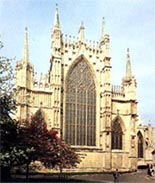 From Roman times to the present day the site on which York Minster stands has
been at the very center of England's religious and political life.
From Roman times to the present day the site on which York Minster stands has
been at the very center of England's religious and political life.


